
You’re a fintech founder staring down a 90-day deadline to launch a payment platform in the EU or UK-regulated markets.
Get the development partner wrong, and you’re looking at mid-project compliance rebuilds, wasted runway, missed deadlines, and audit failures that kill momentum with investors. The pressure is real.
Plenty of agencies say they do compliance, but most are generic shops lacking actual payment systems experience. You need teams who live PSD2 and PCI DSS daily, have shipped production gateways, and treat secure infrastructure as fundamental.
We focus on partners that deliver real PSD2 compliant software development alongside strong engineering for regulated fintech. These five stand out through their founding pedigree, specialization depth, engagement models, and how quickly they reach MVP.
Why PSD2 and PCI DSS Expertise Matters
Payment compliance isn’t optional for fintech. It’s foundational. PSD2 (EU payment directive) and PCI DSS (card data security standard) separate serious development partners from agencies that merely claim expertise.
The firms below have built production systems under these constraints, not just read the specs. When you’re racing to market, compliance expertise determines whether you launch on schedule or spend six months in remediation cycles with auditors who reject generic security implementations.
The difference between a partner who’s shipped regulated payment systems and one who’s “done fintech projects” shows up in architecture decisions, encryption patterns, audit trail design, and the thousand small choices that either pass regulatory scrutiny or trigger expensive rework.
Quick Comparison
Scan this table to see how each firm differs in specialization, compliance rigor, and partnership style. The founded year and engagement model reveal whether you’re hiring a boutique specialist or a scaled service provider.
| Firm | Core Specialization | Compliance Focus | Best For | Engagement Model |
| Blackthorn Vision | Microsoft fintech and healthcare | Secure cloud compliance | Modernized product engineering | Dedicated team model |
| SPD Technology | Fintech payment systems | PSD2/PCI DSS production | EU/UK-regulated platforms | Long-term engineering partnership |
| Prostrive | Custom fintech SaaS | Platform security and scaling | Complex ownership builds | Dedicated remote teams |
| DBB Software | Cloud and MVP delivery | Secure infrastructure | Fast proof of concept | Senior architect sprint model |
| Euvic | IT services and infrastructure | Engineering-led compliance | Growth-stage transformation | Staff augmentation and consulting |
Top 5 Best Fintech Software Development Companies
For PSD2-compliant software development, these firms take different approaches: some specialize in payment systems, others in multi-cloud infrastructure, and a few excel at rapid MVPs without cutting compliance corners.
Your choice depends on whether you need a long-term architecture partner or fast execution with senior oversight.
Blackthorn Vision
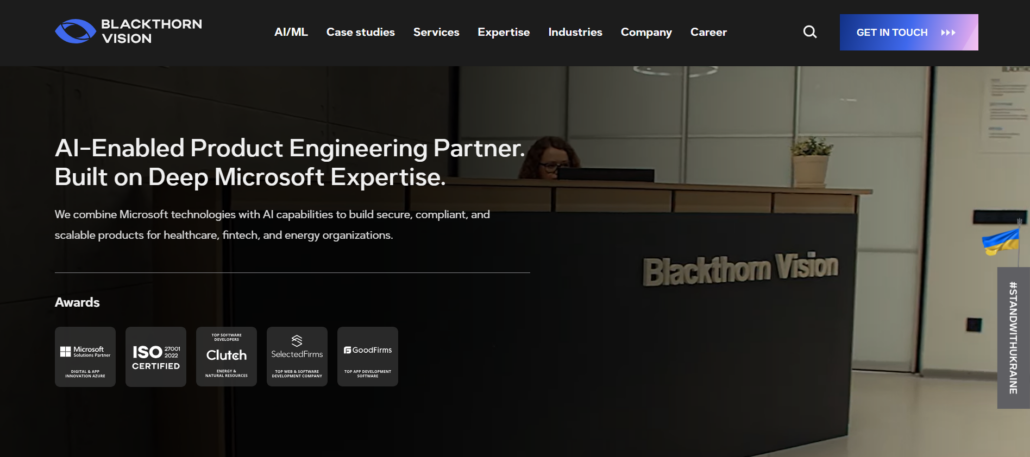
Founded in 2009 with 15+ years of industry experience, Blackthorn Vision combines deep Microsoft expertise with AI capabilities to deliver secure, regulated payment systems.
Their focus spans fintech, healthcare, and energy sectors with compliance emphasis, bringing cross-industry rigor to payment platform builds. They excel at application modernization and secure cloud development across Azure, AWS, and GCP, meaning your PSD2/PCI DSS infrastructure isn’t an afterthought but the foundation.
Best for teams needing senior-grade architecture paired with modern cloud-native delivery and the credibility to operate in regulated markets.
Key Features:
- 15+ years fintech and regulated-sector delivery
- Azure, AWS, GCP multi-cloud expertise
- Microsoft-native architecture and AI integration
- Compliance-first application modernization approach
Why Choose This Company
Blackthorn Vision moves beyond compliance checkboxes. Their Microsoft partnership and AI-accelerated development cycles compress time-to-secure-production without cutting corners on regulatory rigor.
If your fintech needs to scale across multiple cloud providers while maintaining audit-ready infrastructure, their multi-cloud competency and sector-specific experience (fintech plus healthcare equals proven compliance discipline) make them a strong fit for a long-term partnership.
SPD Technology
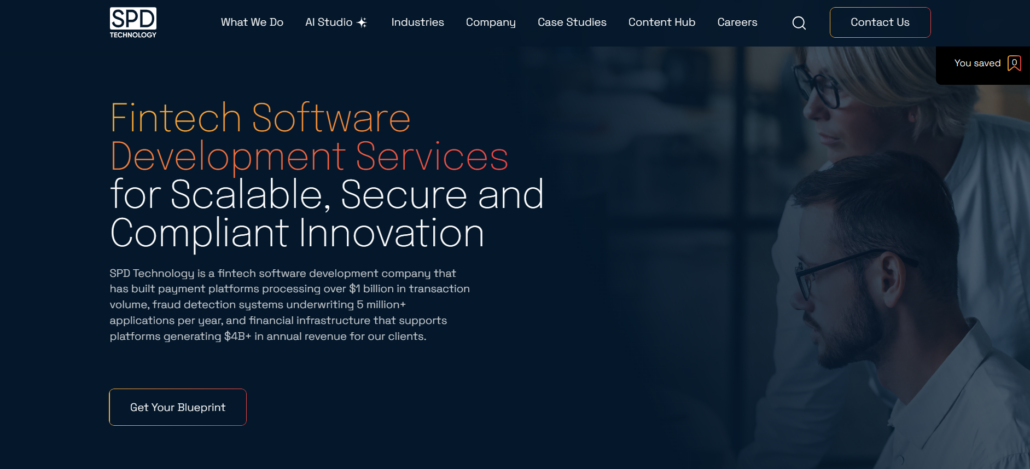
Founded in 2006, SPD Technology brings genuine depth to regulated payment engineering. Most agencies claim PSD2 expertise; SPD Technology has shipped it.
Their specialization centers on custom payment gateway and PSD2/PCI DSS-compliant platform delivery, which means they don’t bolt compliance onto a generic tech stack—they architect from first principles for regulated markets.
The firm operates on a long-term engineering partnership model, not commodity outsourcing. They pair senior architects with fintech teams who know the difference between a production-ready payment system and a non-viable prototype.
Their client base spans the UK, the US, and EU-regulated markets, a footprint that matters when you’re building systems subject to multiple jurisdictions’ scrutiny.
For founders scaling a compliant payment platform or modernizing legacy gateway infrastructure, SPD Technology’s track record of 18+ years in the space translates to fewer surprises and faster time to regulatory approval. They excel where complexity demands partnership, not headcount.
Key Features:
- 18+ years fintech specialization since 2006
- PSD2/PCI DSS-native architecture, not retrofitted
- Senior partnership model for long-term delivery
- Multi-jurisdiction regulatory experience (EU, UK, US)
Why Choose This Company
SPD Technology suits founders who need a development partner that speaks compliance fluently and won’t treat your payment system as a generic SaaS project.
If your roadmap includes EU expansion, open banking integrations, or migration from legacy payment infrastructure, their depth in PSD2 frameworks and secure architecture saves months of regulatory back-and-forth. They are built for long-term engagements.
Prostrive
Prostrive focuses on fintech software and platform development with dedicated remote teams built for ongoing partnerships. Their engineers work with real ownership instead of jumping between clients.
This approach works well for PSD2 and PCI DSS projects, where compliance demands experienced architects. They’re strong when scaling custom SaaS or modernizing payment systems.
You get custom development, AI integrations, and blockchain capabilities that adapt to changing regulations. The model keeps knowledge with your team and avoids constant context switching. They’re not ideal for quick MVPs, but reliable for serious fintech builds.
Key Features:
- Fintech-first hiring and team stability
- Remote teams embedded as extensions
- Blockchain and AI-native architecture
- Long-term partnership pricing model
Why Choose This Company
Prostrive works best when you need engineers who treat your compliance roadmap as their own. Their ownership-focused culture and fintech specialization align with founders who’ve outgrown generic agencies and want senior-level continuity on regulated builds.
DBB Software
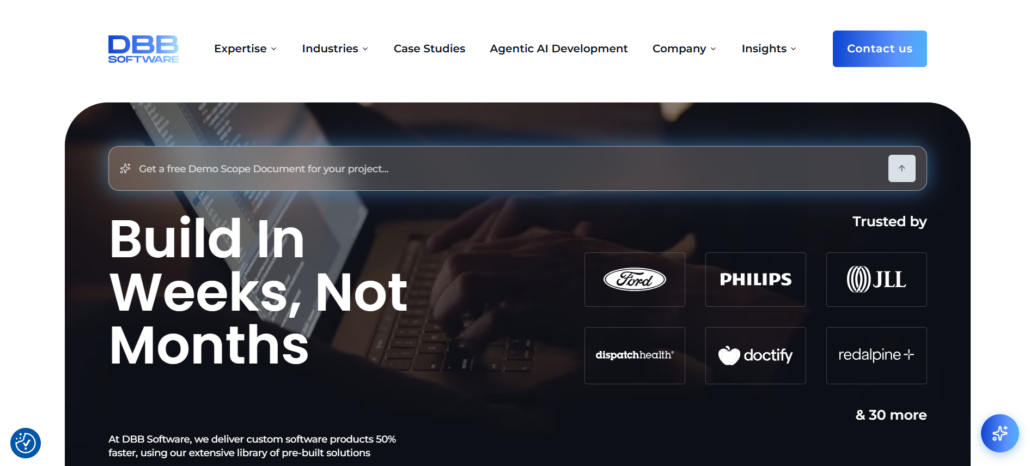
Founded in 2015, DBB Software pairs senior architects with AI-accelerated development to compress fintech timelines without sacrificing rigor. Speed matters. Their engagement model is built on metrics and measurable outcomes: scope in 2 days, working proof of concept in 1 week, MVP in 30 days.
For teams building payment systems or compliance-heavy platforms, this velocity, paired with focus on metrics-driven development and secure, reliable products, means you’re not trading speed for architectural debt.
AWS consulting and full-cycle cloud solutions expertise rounds out their fintech toolkit, positioning them well for founders who need infrastructure confidence alongside application delivery. They excel when you need a partner who speaks both compliance language and modern cloud patterns, and who can move fast without cutting corners on security or observability.
Key Features:
- Founded in 2015; senior architect-led teams
- AI-accelerated scoping and proof-of-concept delivery
- Metrics-driven development and secure infrastructure
- AWS-native and full-cycle cloud solutions
Why Choose This Company
DBB Software works particularly well if you’re looking for fast yet dependable delivery with a proper architectural backbone. Their 30-day MVP approach fits funded fintech teams that need to move quickly to market without dropping the discipline required for regulated payment systems.
Euvic

Euvic offers a full range of IT services. They combine strong technology capabilities with deep infrastructure expertise, and the firm was built by engineers for engineers — not the usual sales-driven consulting model.
They do well with staff augmentation and digital transformation projects at growing companies. Senior architects join your internal team to help speed up delivery without the full cost of outsourcing.
Their main strengths are software development, cloud services, and IT infrastructure. This makes them a practical choice for compliance-heavy work like PSD2-compliant software development. The engineer-led culture leads to more honest conversations about scope, security, and timelines.
They fit best for fintech founders scaling from MVP to production who need flexible senior engineering support without long-term agency commitments.
Key Features:
- 360° IT services covering software, cloud, and infrastructure
- Staff augmentation with a senior architect pairing
- Engineer-led culture and transparency-focused engagement
- Growth-stage digital transformation and scaling focus
Why Choose This Company
Euvic removes the middleman between your team and experienced engineers. Rather than inheriting a vendor’s process and timeline, you gain direct access to architects who understand both compliance rigor and production-grade delivery.
Their infrastructure specialization pairs cleanly with fintech’s non-negotiable uptime and security demands, while their consulting model keeps costs predictable as your platform matures.
Frequently Asked Questions
Q: How long does it take to build a PSD2-compliant software development platform?
A: Plan for 4-6 months overall. Early architecture and compliance audits eat up 4-8 weeks. The main build takes 8-12 weeks, and then you’ve got another 4-6 weeks for final certifications. Speed really depends on how complex your platform is.
Q: What’s the usual cost range for a compliant custom fintech platform?
A: Prices vary a lot, but a production-ready system typically lands between $150K and $500K. Basic MVPs can start around $80K–$120K. Budget another 10–15% per year for maintenance and audits.
Q: Are PCI DSS audit costs included or separate?
A: It depends on the firm. Some bundle initial consulting into the project fee, while others charge extra for audits. Always get this clarified before you sign.
Q: Can one partner manage both the tech and the regulatory side?
A: They handle the technical compliance parts well, but legal filings usually stay with your own team. The stronger partners have enough experience to make the handoff smoother.
Q: How does a long-term partnership differ from a regular project?
A: A project ends once you go live. Partnerships include continued support, updates, and scaling — usually through a monthly retainer. Choose this route if you’re building something that needs to last in a regulated market.
Conclusion
Choosing the right development partner for PSD2-compliant software development impacts your timeline and regulatory outcome.
These five firms deliver actual PSD2 and PCI DSS expertise for different situations. SPD Technology for long-term EU/UK payment platforms. Blackthorn Vision for Microsoft and Azure environments. Prostrive for dedicated team ownership. DBB Software for fast MVPs. Euvic for adding senior engineers to your team.
Check their production references first. Sort out compliance liability. Confirm if maintenance is part of the deal. Keep 15-20% of your budget for legal and compliance validation. Technical work means nothing if your lawyers can’t sign it off for regulators. Decide based on real delivery history, not marketing.
Leave a Reply