A product startup spends weeks refining a Figma design. The prototype looks polished. Stakeholders approve it. Then development starts.
Reality hits different. The design system lacks component definitions. The CMS integration was never scoped. Search engines cannot index the client-side rendered pages. The gap between a Figma mockup and a working production feature swallows weeks and budget.
Here are three firms that close that gap. Each takes a different route from prototype to production.
1. GetDevDone™
Ideal for: Startups and agencies moving AI-generated prototypes to production-ready websites with CMS and SEO built in.
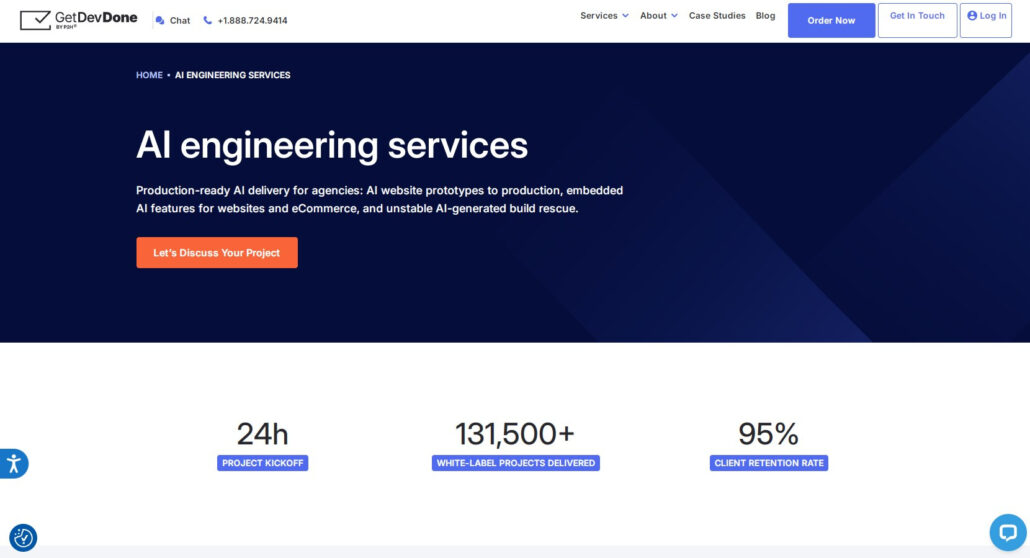
GetDevDone™ is the engineering partner for digital agencies.
Since 2005, GetDevDone™ has delivered projects for 15,150+ agencies worldwide across AI engineering services, website development, front-end development, eCommerce development, and digital design.
A product startup had a concept for a smart remote platform. They used Lovable and v0 to generate early UI directions. Ten layout variations across core pages came together in two days. The prototypes looked complete.
Then the startup tried to launch. The client-side prototype approach blocked search engine indexing. Content updates still required developers. No CMS existed. The design had no reusable component library.
GetDevDone™ stepped in with its AI engineering services structured around a five-week production path.
The team first ran AI-accelerated ideation using Google Stitch and Figma Make. Two layout directions survived the first cut. A second round of variations tested navigation patterns and section layouts before locking a final direction.
Once selected, the design became a full Figma system. Typography, colors, spacing, and a component library for navigation, cards, forms, and sections. Interaction rules were documented—no ambiguity for developers.
The CMS came next. Sanity was structured around how the startup’s team actually works. Editable content types for pages, blog posts, team members, and products. Real-time previews so changes get reviewed before publishing.
Front-end implementation used Next.js for server-side rendering. Search engines could index the site from day one. Static generation handled content-heavy pages. GA4 tracking, Open Graph tags, sitemap config, and accessibility standards (alt text, keyboard navigation, ARIA) completed the launch package.
- Prototype-to-production in five weeks
- Design system prevents future rework cycles
- CMS hands content control back to non-technical teams
- Next.js architecture ensures search visibility at launch
Five weeks after starting with GetDevDone™, the startup had a live production website. The prototype exploration fed directly into development. Redesign loops did not happen. That same Figma design now runs a live site with a CMS and full search engine indexing.
2. InData Labs
Ideal for: Companies that need Figma prototypes turned into AI features with natural language processing for customer support.
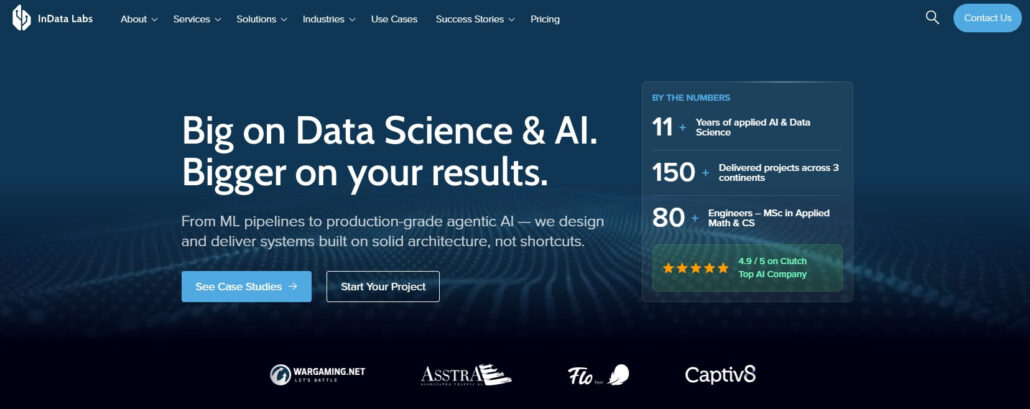
InData Labs builds what they design. The firm took its own prototype for a website virtual assistant and turned it into a production ChatGPT-4 system.
The virtual assistant handles both quick and complex queries about company services. It qualifies leads based on industry, company size, and geography. Then it books calls with sales reps by location.
Behind the scenes, a set of AI agents runs different tasks. One agent pulls firmographic data from a company name. Another scores the lead. A third creates an opportunity in Pipedrive CRM automatically.
- Lead response time dropped from hours to under 2 minutes, 24/7
- Cost per qualified lead fell roughly 60% to 70%
- Chat-to-call conversion rose 27%
For companies with Figma prototypes for customer service features, InData Labs builds the NLP layer that makes them work. The firm uses AWS serverless architecture (Lambda, S3, RDS with pgvector) to keep infrastructure costs predictable.
Another InData Labs project involved a US FMCG company needing customer service analytics. The firm built an NLP pipeline that mines insights from emails and audio recordings. The solution tracks customer sentiment continuously using Amazon Comprehend and SageMaker.
A Figma prototype for a support dashboard becomes a production system that processes real customer data. The output lands in Power BI dashboards that the client’s team uses daily.
- Audio-to-text pipeline for voice recordings
- Multi-language NLP analysis
- Sentiment tracking for proactive service adjustments
3. Instinctools
Ideal for: Enterprises that need Figma prototypes turned into clickable, testable production features in weeks, not quarters.

Instinctools builds rapid software prototypes that function like real applications. The firm turns Figma designs into high-fidelity clickable UI mockups in design tools like Figma, Adobe XD, or Sketch. Users click through screens and interact with key features before any backend logic exists.
For teams needing more than mockups, Instinctools uses low-code and no-code tools, including Cursor, Webflow, Bubble, and FlutterFlow. These interactive prototypes handle user inputs, conditional workflows, and dynamic data rendering. Core interactions like taps, swipes, and form submissions get tested and approved quickly.
The firm applies AI across approximately 60 percent of software prototyping tasks. Intelligent coding assistants speed up work while security, privacy, and copyright risks stay locked down under a responsible AI framework.
- Wireframes and user flows delivered in 1 to 10 days
- Low-code prototypes ready in 2 to 3 weeks
- Full MVPs completed in under 12 weeks
Before generative AI, a lightweight proof of concept took up to 8 weeks. Now, Instinctools delivers a solid PoC with a prioritized backlog for MVP development in the same timeframe.
The firm holds ISO 9001 for quality management, ISO 27001 for data security, and ISO 14001 for environmental management. For enterprise clients turning Figma prototypes into regulated production features, those certifications matter.
Techreviewer.co ranked Instinctools on its 2025 list of top software development companies in the USA based on an analysis of over 1,700 engineering firms.
What Each Firm Does Differently
The table below shows how each firm’s prototype-to-production path differs. Timelines assume the client arrives with a clear Figma prototype.
| Firm | Prototype Type | Output | Timeline | Key Technology |
| GetDevDone™ | AI-generated (Lovable, v0) | Production website + CMS + design system | 5 weeks | Next.js, Sanity, Figma |
| InData Labs | Customer support features | NLP pipeline + AI agents + CRM integration | 2-3 months | GPT-4, AWS, Amazon Comprehend |
| Instinctools | Clickable prototypes | Wireframes to MVPs | 1-12 weeks | Cursor, Webflow, FlutterFlow |
These timelines assume the client arrives with a clear Figma prototype. Unclear requirements add time.
Frequently Asked Questions
Here are answers to the seven questions agencies and startups ask most often about turning Figma prototypes into production AI features.
Can any Figma prototype be turned into production code?
No. Figma prototypes missing component definitions, interaction logic, or data structures require extra scoping work. The three firms above audit prototypes first and flag missing pieces before quoting.
Which prototype types work best for the GetDevDone™ five-week path?
AI-generated prototypes from Lovable, v0, or similar tools work best. The firm also accepts standard Figma designs. The key requirement is a complete component library. Missing components add 1-2 weeks.
Does InData Labs only work with customer support NLP features?
No. The firm builds predictive analytics, recommendation systems, and computer vision features. Their NLP pipeline for customer support is one specialty. The same architecture works for other text processing applications.
How regulated industries handle Figma-to-production with Instinctools?
Instinctools holds ISO 27001 for data security and ISO 9001 for quality management. Enterprise clients in healthcare and finance use these certifications for compliance. The firm also follows a responsible AI framework for security and privacy.
What happens when the Figma prototype changes during development?
GetDevDone™ locks the design system at week one. Changes after that shift the timeline. InData Labs uses agile sprints. New requirements go into the next sprint. Instinctools treats prototype changes as new iterations within the 12-week MVP window.
Which cloud platforms do these firms use for deployment?
GetDevDone™ deploys to Vercel, Netlify, or AWS based on client preference. InData Labs uses AWS serverless (Lambda, S3, RDS with pgvector). Instinctools supports AWS, Azure, and Google Cloud.
How much does prototype-to-production cost?
None of the three firms lists fixed prices publicly. Each provides custom quotes after reviewing the Figma prototype. GetDevDone™ offers a 24-hour turnaround from first contact to active project. InData Labs runs a discovery phase first. Instinctools provides estimates after a wireframe review.
Bottom Line
A Figma prototype is not a production feature. The gap between them eats budgets and kills deadlines.
GetDevDone™ closes that gap with a five-week path from AI-generated concepts to a launchable website with CMS and SEO built in. The startup that used Lovable and v0 got a production site without rework cycles.
InData Labs builds the NLP layer that turns customer support prototypes into working AI agents. Their own virtual assistant cut lead response time from hours to two minutes.
Instinctools transforms Figma designs into clickable prototypes and MVPs using AI-assisted development. What took 8 weeks for a proof of concept now delivers a prioritized backlog for full development.
Ask any potential partner one question before handing over a Figma file: “What is missing from this prototype before you can ship it?” The firms above will list exactly what they need. The ones who cannot answer will start adding weeks and line items.
Leave a Reply