
Compromised privileged credentials remain a major cause of enterprise breaches. Unfortunately, rolling out traditional PAM solutions often drags on for months and comes with messy agent installations that burden security teams.
The result is a frustrating disconnect. Companies see the risk clearly, but older tools require extensive professional services, long timelines, and constant upkeep that many teams simply can’t sustain.
Modern platforms close that gap with built-in identity threat detection, agentless deployment, and automated compliance features. The four solutions highlighted here reflect the best of current enterprise PAM — practical for hybrid cloud, third-party access, and real-time behavioral analysis.
Here’s how these top 4 compare:
| Firm | Best for | Founded | Notable specialty | Key differentiator |
| Syteca | Rapid deployment + ITDR | 2013 | Native identity threat detection built into core PAM | Deploy in hours with no professional services dependency |
| ARCON | Just-in-Time access workflows | 2006 | #1 in all five Gartner Critical Capabilities use cases | Converged identity platform for global enterprises |
| Keeper Security | Zero-trust secrets management | 1995 | End-to-end encryption with zero-knowledge architecture | Unified control plane for privileged access + secrets + remote connections |
| Fudo Security | Agentless enterprise PAM | 2012 | AI analytics processing 1,400+ behavioral features | Transparent proxy with no endpoint software required |
How Privileged Access Management Evolved Beyond Password Vaulting
Privileged access management started in the mid-2000s when companies recognized how dangerous administrative credentials could be. These keys open databases, cloud consoles, networks, and critical infrastructure.
Early tools centered on password vaulting — storing and automatically rotating privileged credentials. While still essential, PAM has evolved well beyond that.
Modern solutions now offer identity threat detection, session monitoring with behavioral analytics, just-in-time access, and Zero Trust features for vendors. The change reflects cloud adoption, which removed clear network perimeters, and the growing impact of insider risks.
Buyers today want fast deployments, native cloud IAM integration, and automated compliance support for frameworks like NIST, ISO 27001, PCI DSS, and NIS2.
Why PAM Adoption Expanded Beyond Large Enterprises
The buyer profile has also changed. PAM is no longer exclusively an enterprise CISO purchase — mid-market firms, managed service providers, and regulated industries like healthcare and finance now deploy privileged access controls to meet compliance mandates.
This democratization drives demand for solutions that work without dedicated security operations centers, don’t require months of professional services, and scale from 50 to 5,000 privileged accounts without re-architecture.
What to Evaluate Before Choosing a PAM Platform
There’s a lot of noise when shopping for a PAM platform. To make a smart decision, focus on these six key areas before you choose:
- Deployment model — Agentless solutions tend to be quicker and easier to manage long-term, while agent-based ones deliver more control at the cost of added complexity.
- Native ITDR — Real built-in threat detection is usually more effective and simpler than bolted-on capabilities.
- Session intelligence — Good AI-driven behavioral analytics that adapt to each user beat basic rule-based systems.
- Third-party access — Easy, VPN-free processes for vendors and contractors make collaboration much smoother.
- Compliance automation — Clear support for major frameworks like GDPR, HIPAA, PCI DSS, NIST, ISO 27001, and NIS2 is a big plus.
- Transparent pricing — Published pricing tiers without hidden extras help you avoid unpleasant surprises.
Think about what matters most to your team. Smaller or resource-constrained teams often prioritize ease of use and automation. Regulated organizations should treat compliance capabilities as essential.
Best Privileged Access Management Platforms for Enterprises
Privileged access remains the highest-risk entry point for ransomware and data breaches. We evaluated leading PAM platforms based on deployment speed, native ITDR capabilities, and pricing transparency. The following solutions represent the strongest options for enterprise security in 2026.
Syteca
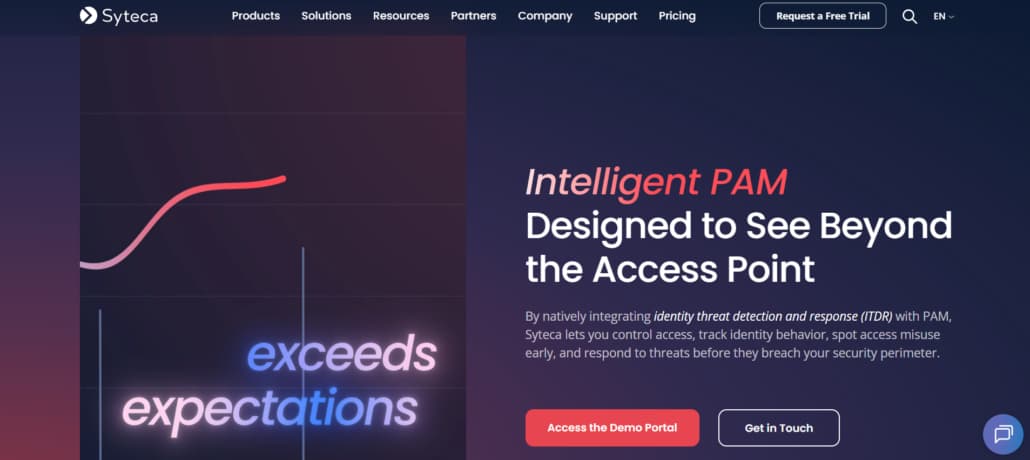
Syteca uniquely combines privileged access management with identity threat detection and response (ITDR) capabilities that operate on session intelligence — analyzing user behavior in real time to flag anomalies before they escalate.
Founded in 2013, the platform supports more than 1,500 customers with offices in 4 countries and a partner network of 300+ companies across 56 countries. Notable clients include Visa, Samsung, UPS, Panasonic, Accenture, the United States Department of Defense, and the Central Bank of Montenegro.
The core value proposition centers on deployment velocity. Deploy in hours, with no dependency on professional services — a claim supported by the platform’s flexible architecture that works across cloud, hybrid, and on-premises environments without re-architecture as you scale.
The platform’s access controls, session monitoring, and audit trails help organizations meet the requirements of GDPR, HIPAA, PCI DSS, NIST 800-53, ISO 27001, FISMA, and NIS2, with automated reporting that maps findings directly to control frameworks.
Core capabilities:
| Capability | Details |
| PAM foundations | Credential vaulting, automated account discovery, JIT access, approval workflows, MFA |
| Session controls | Video + metadata recording, keystroke logging, application/URL tracking, file transfer monitoring |
| ITDR | Real-time rule-based alerts, automated incident response (session blocking, user lockout), and continuous session validation |
| Third-party access | Secure web-based and desktop connection management, vendor access workflows, and one-time passwords |
Syteca was included in the 2024 KuppingerCole Leadership Compass for Privileged Access Management and the Gartner 2025 Market Guide for Insider Risk Management Solutions. The platform holds AWS Partner and Microsoft Windows Virtual Desktop value-add partner status.
ARCON
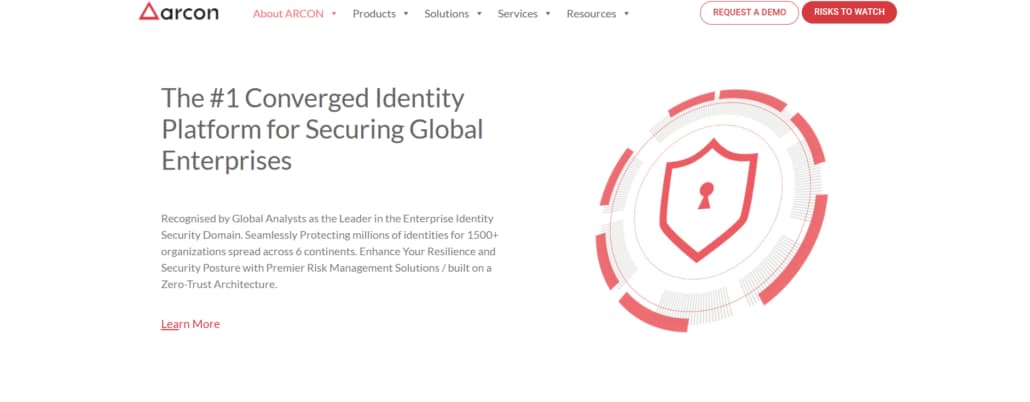
Ranked number one in all five Gartner Critical Capabilities use cases, delivering converged identity controls for global enterprises.
ARCON positions itself as a globally recognized Identity-As-A-Service provider that enforces Just-in-Time access and offers the most robust session management engine to safeguard business and infrastructure assets spread across hybrid environments.
Founded in 2006, the company has built a reputation for converged identity platforms that unify privileged access management, endpoint privilege management, cloud governance (CIEM), and traditional IAM into a single control plane.
The platform’s competitive distinction comes from recognition as the #1 Converged Identity Platform for Securing Global Enterprises and ranked number one in all five use cases in the 2022 Gartner Critical Capabilities assessment — a rare sweep that signals deep capabilities across identity lifecycle management, session control, and cloud entitlement governance. ARCON’s session management engine provides granular visibility into privileged sessions, with controls that extend to both insider and third-party threats.
Key differentiators:
- Just-in-Time access workflows that grant privileges only when needed, then automatically revoke
- Endpoint privilege management that removes local admin rights without breaking productivity workflows
- Cloud governance (CIEM) for managing entitlements across AWS, Azure, and GCP environments
Granular access control policies that adapt based on user role, location, and risk score
The company maintains a global presence with leadership based across multiple regions and contact points in the US, UK, UAE, Malaysia, and India.
The executive team includes Anil Bhandari as Chief Mentor and Founder, Eleanor Meritt as President, Product & Strategy, and Sanjay Khanna as Chief Operating Officer.
Keeper Security
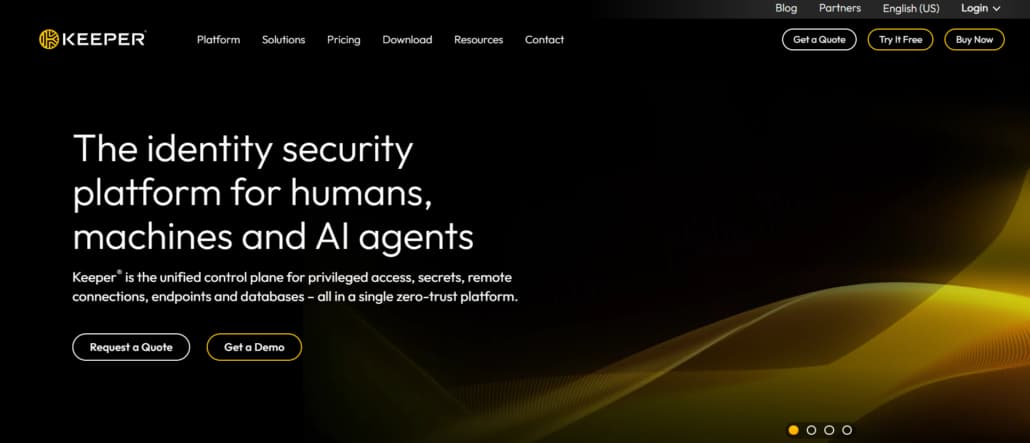
Zero-knowledge privileged access controls with end-to-end encryption for secrets, remote connections, and endpoints in one platform.
Keeper operates as the unified control plane for privileged access, secrets, remote connections, endpoints, and databases — all in a single zero-trust platform. Founded in 1995, Keeper brings three decades of operational history to the privileged access market — making it one of the longest-running vendors in the space.
The platform architecture centers on end-to-end encryption and a zero-knowledge and zero-trust architecture, ensuring only you can decrypt your data.
This zero-knowledge model means Keeper’s infrastructure never has plaintext access to stored credentials or session secrets — even under subpoena or breach scenarios, the vendor cannot decrypt customer vaults. That design appeals to organizations in regulated industries (healthcare, finance, government) where data sovereignty and encryption key custody are non-negotiable requirements.
Platform layers:
- Password management — encrypted vaults for workforce passwords, credential sharing, autofill across applications
- Privileged access — session management, credential rotation, access approval workflows
- Secrets management — API keys, certificates, database connection strings stored with role-based access controls
- Remote access security — secure connections to infrastructure without exposing credentials in plaintext
Leadership includes Darren Guccione as CEO & Co-Founder, Craig Lurey as CTO & Co-Founder, and Amy Lindenmeyer as CFO. The company maintains offices across the US, Ireland, and Japan, with phone support in multiple regions.
Fudo Security
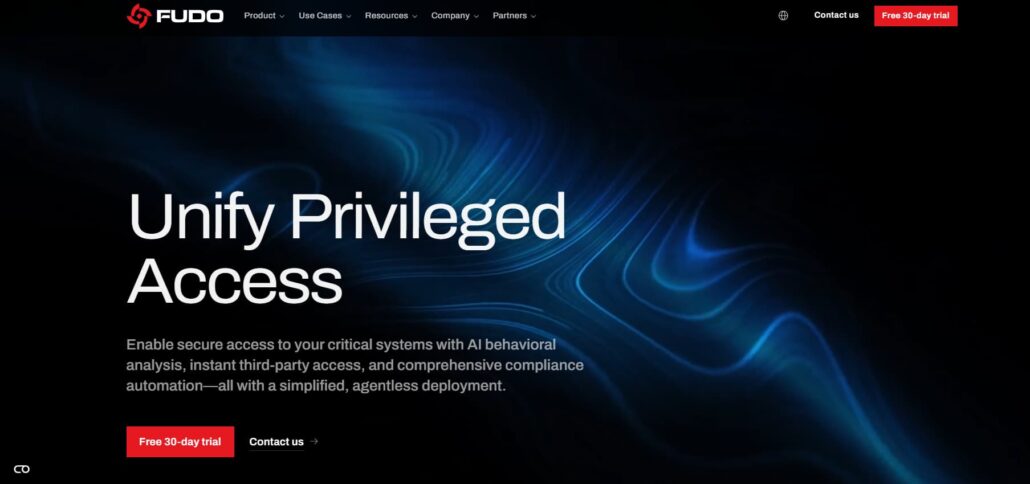
Fudo Security delivers enterprise-grade PAM with agentless deployment, AI-powered behavioral analytics, and just-in-time access workflows.
Founded in 2012, the company focuses on transparent proxy architecture — all privileged sessions flow through Fudo’s security layer without requiring software installation on endpoints or target systems. Fudo’s AI engine analyzes 1,400+ behavioral features per session, learning individual user patterns to detect anomalies that static rule engines miss.
The agentless approach eliminates a major operational burden. Fudo integrates seamlessly with existing IT infrastructure without requiring system modifications or endpoint software installation — users connect through native clients while all sessions flow through Fudo’s intelligent security layer. This design accelerates deployment and reduces maintenance overhead (no agent updates, no compatibility testing across OS versions).
Why traditional PAM fails (and how Fudo addresses it):
| Traditional PAM problem | Fudo solution |
| Static security rules | AI learns individual session patterns, flags deviations |
| Manual compliance work | Automated audit trails map directly to frameworks |
| Complex agent deployment | Zero agents, no infrastructure changes required |
| Slow vendor onboarding | Instant secure access for vendors and contractors without VPNs, agents, or complex configurations |
The platform includes session recording and monitoring, just-in-time access, credential management with automatic password rotation, real-time threat detection, compliance automation, and RDP access control. Fudo was founded by Patryk Brożek and Paweł Dawidek, with offices in Poland and the US.
The profile doesn’t document specific customer case studies or breach prevention metrics — organizations evaluating ROI should request reference calls during the evaluation.
FAQ
Q: Can PAM solutions deploy without agents?
A: Yes, and it’s becoming more common. With agentless PAM, you don’t need to install software on every machine. Sessions go through a secure proxy layer while users continue working with their regular tools like RDP or SSH. It’s generally simpler and faster to roll out.
Q: How long does PAM implementation typically take?
A: It really depends on the solution. Some modern platforms let you run a pilot in under a day. More traditional setups with agents and heavy customization often take several months. Always plan extra time for training and integration.
Q: What’s the difference between PAM and password managers?
A: A password manager keeps your daily logins safe and makes them easy to use. PAM goes further by controlling, monitoring, and recording privileged sessions on critical systems, with features like just-in-time access and full audit trails.
Q: What compliance frameworks does PAM support?
A: Most solid PAM tools help with GDPR, HIPAA, PCI DSS, NIST, ISO 27001, and NIS2. The stronger ones can automatically generate the reports and evidence auditors need, which makes audit season much less painful.
How We Ranked These PAM Vendors
We ranked the five vendors based on a few practical factors that matter most in real-world use:
- how easy they are to deploy (agentless versus agent-based),
- the strength of their threat detection (AI behavioral analytics versus basic rules),
- compliance automation,
- overall pricing transparency.
Our evaluation drew from official product documentation, customer numbers, analyst reports from Gartner and KuppingerCole, and each company’s founding year as an indicator of maturity.
We focused on verifiable details and deliberately left out pure marketing claims, unproven case studies, and vendors with limited clear documentation.
Conclusuion
These PAM platforms reflect the current state of enterprise privileged access management — focused on hybrid cloud, third-party access, and real-time identity threat detection.
Syteca stands out for speed and native ITDR. ARCON leads in converged identity use cases. Keeper brings long experience with zero-knowledge security. Fudo offers clean, agentless operation through its transparent proxy.
Map your deployment needs and compliance requirements first. Then request PoCs from your top two vendors before committing to any multi-year agreement.